 Shaohua

From NetEase:
Whether you are blue collar, white collar, or grey collar, as long you have a caring heart, you are a red collar!
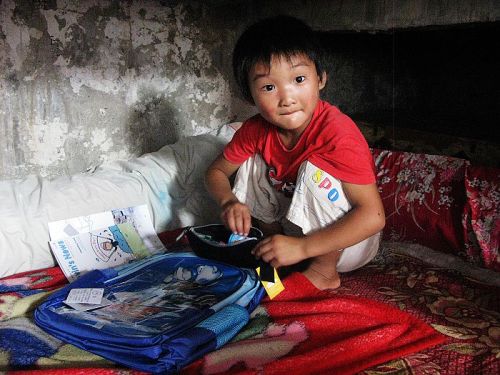
In Shanghai, as well as in other large and small cities, live this group of people.
They may work in the heart of the city, but it seems they live on the city’s edges. Doing hard labor–construction, selling vegetables, or collecting rubbish, some of which are full of danger–cleaning the walls of high rise buildings, mining, and chemical industry jobs.
Compared with calling them “ming gong” or “nong ming gong”, society is now more willing to to call them “outside labor staff.” Even though this is long-winded, it is very humanistic, and also more accurate.
September 21, Sunday, Chevrolet Charity Teaching and Shanghai Youth Media volunteers came to Shanghai Chongming County Lu’an children’s school for two days of teaching. The 400 students there come from Anhui, Guizhou, Sichuan, Henan, and other provinces and cities, and are all children of “outside labor staff.”
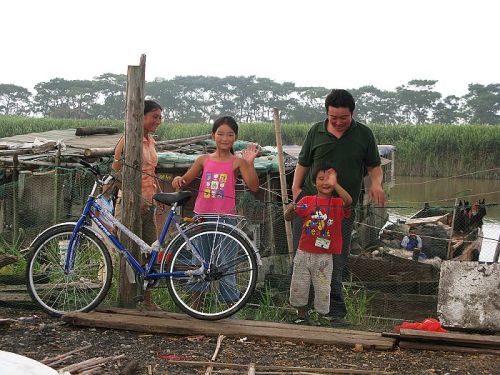
21st and 22nd, after two days of volunteer teaching, the children’s smiles, strength of will, moving, dreams…gave everyone distinct impressions. Visits to the homes of these children left us with even more distinct impressions.
When we arrived in Chongming, we first visited the children’s homes. The head of the Lu’an school took us to several of the poorest student’s homes. Compared to the orderly buildings of Chongming’s native residents, these “shanties” could hardly be called houses, their roofs covered with thick plastic cloth and straw to protect against the rain.
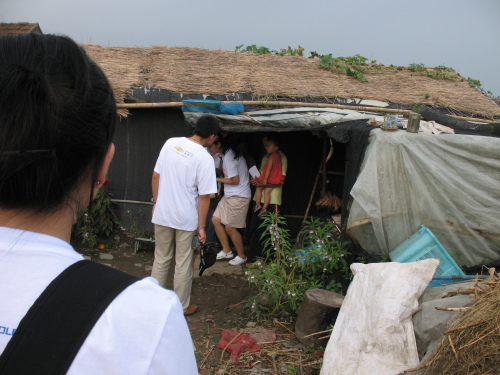
We visited a total of five families, some of whom lived in abandoned buildings, some lived in the fields in shanties they erected on their own. Every house left a deep impression on us.
One of the families, lived in what looked like a storehouse. From the highway to a small road, through a field full of plastic greenhouses, we arrived at our destination. On the road, a man on a motorcycle followed our “Red Collar Movement” Chevrolet Aveo convoy to our destination. After parking, they chatted with us: “Where are you all coming from?” “Are you all from the same work unit?” “What are you coming her for?” “How much does this car cost?”
Volunteers followed along the small road, getting close to that “storehouse.” Only after seeing did we know that there were actually several homes there. Each home used plastic cloth bag-like tarps as separators, the inside was dim, every “plastic tent home” lit with a single dim, low-power light bulb.

Here, we encountered a little girl, Mao Jiao-jiao, 8-years-old, attending first grade. Seeing the volunteers surrounding the entrance to the “plastic tent home” next door, and not stopping for a moment, she directly walked into her “home.”
We followed her in.
Her home was a total of only 10 square meters, on the left side was a large double-person bed, on the right side was a single person spring bed, and across from us a small table. It was crowded to the point where you almost could not enter. Jiao-jiao said that her father, mother, and herself sleep on the big bed, and her brother who has entered the sixth grade sleeps on the small bed.
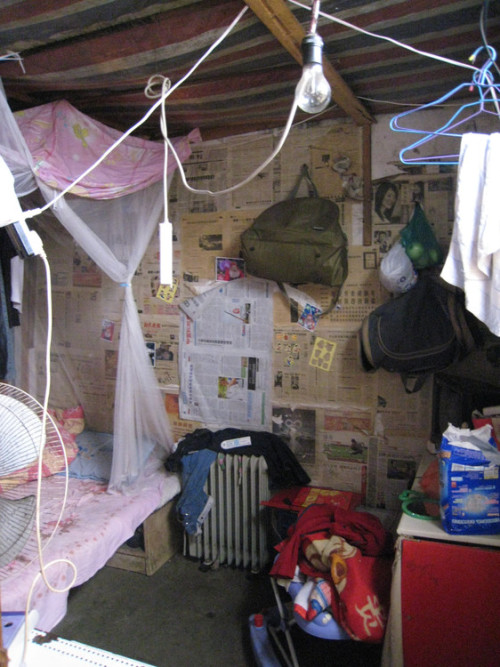
She climbed onto her brother’s small bed and struggled to reach a box that was hung the “wall” (plastic cloth tarp), a very ordinary paper box, like the packaging that comes on food products.
Then, from within she took out a notebook, a Xinhua dictionary, and some paper.
I was startled, asking if this was her book bag.
Fortunately, she said it wasn’t. These were her brother’s.
On her face was an abrasion the size of a 1 RMB coin, the blood having scabbed to a black color, clearly a wound that was a few days old. She said it was from a fall, and that it doesn’t hurt.
At this time, a television reporter cam in. In the middle of the dim plastic tent, before a video camera, Jiao-jiao would no longer talk, hung her head, and fiddled with her notebook. On one page were vocabulary words, and turning to another page was her homework. Her handwriting was neat. She should be a student with good grades
Right before we left, we saw on the table a national ID card, belonging to Jiao-jiao’s father; address: Guizhou xx Tu [ethnic minority] autonomous area. This was Jiao-jiao’s old hometown.
Coming out of the visit to the “plastic tent home” storehouse, the man with the motorcycle had not left, strolling beside our Chevrolet Aveo. Seeing us come out, he started to make conversation. He pointed not far to the plants inside a large greenhouse saying: this is asparagus, only a small part could be sold, the rest is thrown away. On the side of the road over there are pumpkins. My family also plants these.
“Is the greenhouse expensive?” a volunteer asked.
“Not expensive!” he said loudly and clearly.
At this time, a volunteer from the Shanghai Times quietly said: I asked a vegetable farmer earlier who said that renting a greenhouse is very expensive, at least 1000 RMB. They could not afford to rent it.
At this time, another team of volunteers sent a text message. They had visited the home of a little girl called Xu Miao-miao. Miao-miao is 13 years old this year, and because of her family’s hardships, had only attended the first grade at school up until last year. “Her father is a Jiangsu fisherman, who was injured 8 years ago while fishing, and is no longer capable of labor, so the whole family depends on the mother picking up trash and doing odd jobs for a living. They live on a fishing boat, but the boat no longer works because all of the spare parts worth anything were sold off.
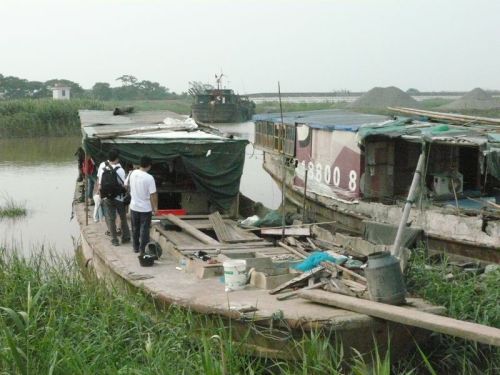
But the Miao-miao’s heart’s desire astonished everyone: My biggest heart’s desire is to catch the school bus everyday, and go to school to study! From her home to the school, she must first ride a bicycle half an hour to reach the school bus stop, and then ride the school bus to the school. When it rains, if she rides too slow, she will not catch the school bus, and cannot go to school.
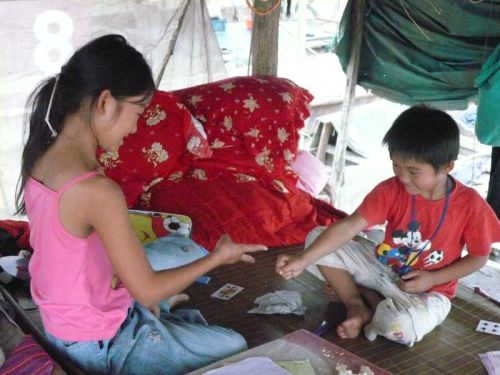
Good news is, with the help of extra lessons from her teacher, this year, Miao-miao has skipped a grade, and was transferred to the third grade. The volunteers were all very happy when they heard this news. That day, on that dim small fishing boat, on that dark little desk, Miao-miao wrote her homework. She was with her 7-year-old little brother, working hard to get closer to her dream.
The post on NetEase was originally from the 2008 September 24 post on the Chevrolet Red Chalk Program (Chinese) blog on Sina.
Comments on NetEase:
猪八姐 (zhu ba jie):
The children of migrant workers…

piruyi:
How difficult…
卢立 (lu li):
I am currently researching how to solve this problem, interested netizens please contact me, and we can strive towards researching a workable and rational proposal.
宁俭堂徐 (ning jian tang xu):
Shanghai is like this, and it can be imagined for other places.
Housing for migrant workers is a major problem. Asking them to afford a house in the city these days is a fantasy.
At present, the most important thing is to allow their children to study in the city for free, something the local government can do. Studying in the city will them more easily integrate into the city. Only when rural people can integrate into the city will it be possible to solve the peasant problem.
林子那边 (lin zi na bian):
If the present discriminatory hukou system is not changed, the country’s welfare system not sound, it will be very difficult to change this kind of unfair situation.
纳兰宇哲 (na lan yu zhe):
A poor home, this kind of living environment, gives children a premature understanding of this society, a premature understanding of bearing hardship.
superupup:
What use is it for you guys to go have a look? Get a television station to film a little, then write to some leader singing praises of him being loving, generous, benevolent to the people. Are not those people still in the same situation? Doing motherfucking useless things, wanting to go show yourselves as being strong and successful people. You guys have superiority complexes. I am too lazy to even despise you.
paulyuling:
Can these seedlings grow up?
Are they our country’s seedlings?
liranar:
They usually have even smaller children staying at home being looked after by their grandparents, there are a lot of people there who have 3-4 children. There are many impoverished rural areas with poor people who have 3-4 children. Guangdong, Puning, and other places I have seen 6-7.
If people in the cities also had so many children, their situation would not necessarily be any better than them.
The most important thing is self-improvement, including having less children, and only then can you give your child a better living environment. To get others help, one must first help themselves.
If the cities and countryside all had more than children, who will depend on who?
08/10/05 UPDATE: Thank you, nathan (commenter below), for correcting our previous errors. – Fauna

16 Comments
Leave a Reply3 Pings & Trackbacks
Pingback:Chinese Discuss Pictures of American Poverty
Pingback:Behind the curtain… - The diary of Jakob Knulp
Pingback:Global Voices Online » China: Debating hukou reform