 Fauna
Fauna

Earlier this week, some Chinese noticed a strange piece of news on Tsinghua University’s website:

Clicking that circled link led to the following news article and interview:
[English Translation]
Yesterday afternoon, Tsinghua University principal Mr. Gu Binglin expressed his worries about current university education conditions during an interview with a student reporter. He indicated straightforwardly that the university education system is in effect “pouring shit into the students minds.”
Principal Gu Binglin indicated that the 1900s-1940s could be considered the golden age for Chinese education circles. During this short period of time, China’s universities trained large quantities of outstanding talents for society, amongst them great thinkers and educators, righteous political revolutionaries and anti-Japanese resistance heroes, and the backbone of scientific knowledge and national elites. But this flourishing situation began to deteriorate following the Liberation and especially during the 1990s. Today’s various institutions of higher learning, including Tsinghua and Beijing University, no longer have the educational goal of fostering talent. Serious academic corruption, dry and irrelevant to society curriculum, and rote memorization teaching methods will lead to students developing rigid ways of thinking, losing interest in the curriculum, losing confidence in the college and even China’s entire education system. dropping out of school to express their disappointment with the university education system in the most extreme way.
He further indicated that some 80% of the student first entering college are full of will and determination to study diligently, but under the the grinding and corrosion of their four year university career, he is afraid not even 20% can maintain this determination up until graduation. Skipping class, cheating on tests are already regarded by many students as par for the course. The original goal and motivation for going to college to gain knowledge becomes purely just get a diploma. Moreover, those students who try their best and take their studies seriously, their learning abilities and creativity are actually being obliterated. their learning capability and innovation ability are actually gradually being destroyed. If this kind of situation continues, the university’s ultimate finished product will be soul-less zombies.
If this continues, 20 years later, who knows what mental state and psychological condition China’s university students will have? I am afraid to imagine!”
The old-fashioned methods of teaching and teaching material caused our society to lose many Da Vinci’s and Bill Gates. Regarding these losses, do we want to engage in introspection? Under such educational methods, students’ psychologies receive the most extreme harm, their creativity and independent thinking abilities are strangled beyond repair. Up to now, China has no Nobel prize winners, which has a lot to do with this kind of education patterns.
Below are Mr. Gu Binglin’s own words:
As president of a university, I believe a real university should foster students’ independent skill, unique thinking methods, and the spirit to challenge authority.
1. What is “independent skill?”
It is not rigidly adhering to the textbook. If you thoroughly researched some thing, you can consider the results of that research to be an achievement in itself. We must encourage and develop this kind of thinking, because the market and the students need such encouragement!
2. What is “unique thinking methods?”
The unique thinking methods does not mean sudden genius, but rather the mindset of trying different things to find solve problems, of grabbing hold of a line and then feeling your way forward. With this kind of scientific spirit, this line can certainly lead to the Nobel. Unique thinking methods are born out of unceasing study, where the student must pay attention to the methods of research, the research goals, as well as the rationality. Of course, the Nobel prize should not become the ultimate objective of the education system, whose ultimate objective is to train and foster talented people, but this is after all the international symbol to recognize the highest talents.
3. What is “challenge authority?”
I trust this students all understand: Of the feather and the stone, which touches the ground first?
This is something everyone all knows, why is it at time only 1 person proposed a different answer and at that time proved with the fact The reason is because of authority’s deterrence. Professor: This noun is an elder’s now, I do not mind others calling me schoolmate, calling me brother, or a student. Because a disciple need not be inferior to the teacher, the teacher is not necessarily more worthy than the disciple, understanding has beginnings and ends, and everyone has their own different expertise. If your research results are better than the teacher’s, then you are the teacher. I can stop the class for a classmate’s “nonsense” question and mobilize everyone to discuss this question, but for what reason? Next to this question just might very well be the Nobel prize…
Of course, it is impossible to give the the above abilities to the students under China’s present education system. Therefore Mr. Gu Binglin indicated that organizational reform is imperative for China’s higher education, “must cease strangling talent ! Must cease pouring shit into students’ minds!” Certainly, reform will involve a lot of unknown factors, as well as implicate many people’s benefits, and is bound to meet enormous resistance, but in consideration of the students and of China’s future, these obstacles must be overcome.
The next day, there was this notice:
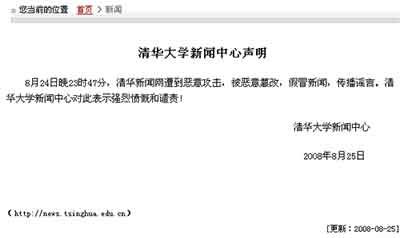
[English Translation]
Tsinghua University News Center Statement
On August 24th at 11:47pm, Tsinghua news website suffered a malicious attack, was maliciously hacked, with impersonated news and rumors propogated. Tsinghua University News Center strongly resents and condemns these views.
Tsinghua University News Center
2008, August 25
China’s prestigious Tsinghua (Qinghua) University was hacked.
News of this spread quickly across the Chinese internet with articles on many news portals, and thousands of BBS forum topics and comments on major Chinese websites like NetEase, Tianya, and Sina.
Comments on NetEase:
A lot of the content is true…
It was always the truth,
But this society insists on compelling others to say lies,
Even framing others as hackers!
In the future, anyone who posts a political opinion online can be framed as a hacker.
Well done!
Who wrote this? I support whoever it is to be a Tsinghua professor!
What this hacker said is absolutely correct!!! The day Tsinghua’s president really dares to say this kind of stuff is the day our universities have hope!!!
Did Tsinghua’s pageviews drop recently?
Speak the truth once and they need to use innumerable lies to cover it up.
My four years in university:
First Year: Diligently studied math, English, and the like (Work proved that these were the most useless).
Second year: Did not go to class during the semester. One week before tests, diligently bribe the teachers to reveal the test topics in advance, so there is no problem passing the test.
Third year: Gamble, girlfriends, waste time!!
Fourth year: …do not remember what I did.
Summary of reflections after graduation:
I wasted my tuition and four years of my youth!!! I believe I can represent 95% of college graduates!!
Even if you diligently studied, what use would it be! Whatever major you studied would be no better than what you could learn at a technical/vocational school!!
Chinese universities is a place for wasting time!
I am a professor: I appreciate the hacker for speaking what is in my heart.
“What did I do the entire time I was in university!!!”
“University did me for 4 years!!”
Bullshit!!
If you yourself do not work hard, only knowing how to put your hopes on other people, then you are also useless!!
Although this society or university has a lot of bad things!!
Use your brains, move your bodies!
And you will naturally learn a lot of things!!
Even in the dark, you can learn how dark it is!!
If you complain you learned nothing in university!!
Then when I only feel an intense superiority over you when look at you.
Only pigs can learn absolutely nothing.
After finishing my first year of university, I suddenly realized that something was not right. thereupon I went to a training school on one hand and wasted my time in university on the other. After I had finished my second year, my dad said college tuition was too expensive, that it would be difficult for the family to support me, so I completely stopped attending college. My last two years, I worked part-time and studied at the training school part-time. When it was time for my old university schoolmates to graduate, I was ready to change jobs. When we applied for the same jobs, I always won. So, I have a good conclusion: Today’s education, today’s universities, you have really harmed a generation of people!
I was a good student, but when I got into college, my schoolmate did not. Four years later, when I had graduated and was searching everywhere for a job, my old schoolmate had already earned enough money to buy a 200,000+ RMB car while I have not even found a job. This is education, I do not believe that just because I attended school for several more years, I can earn 20,000 RMB more every month.
Overall, college’s biggest contribution:
- Provided the country a huge amount of financial revenue;
- Provided young people a common place to improve: video games, watching movies, drinking alcohol, etc.
- Provided society with a batch of ambitious but low-skilled so-called “talent.”
I really hate those so-called “hackers,” .386 mov eax, esp who does not know how?
Whether it is your university or some other place, you must always depend on your own hard work, and not simply blame your environment.
I know all the people above definitely could never get into Tsinghua and are just trying to make themselves feel better.
I did college for four years, but it feels like college did me for four years.

So-called China’s best sciences and engineering university, famous for being China’s strongest computer science specialty, only to have their own website hacked, really is too hilarious.
I am from Tsinghua University. I strongly condemn the hacker’s actions. Haha. Once again I condemn you!
A: Are you from Tsinghua?
B: You’re from Tsinghua, your whole family is from Tsinghua…
A: Your family’s eight generations of ancestors are all from Tsinghua…
[This joke originally involved China’s embarrassing national football team]
If this is real, then the pace of China’s educational reforms must speed up;
If this is fake, then it proves that Tsinghua’s computer department has no talented people, that even their own front door has been messed with.
Maybe this hacker is a Tsinghua student!!!
Hacker brother, please attack the Chinese Securities Supervisory Association’s website, I beg of you! Those bastards are useless! [China’s stock market has performed very poorly for some time now]
This hacker is so strong. China’s genuine talented people have only two options: one is to be buried by the bullshit leadership, a lifetime of misery; two is blend in with the normal people, never to be discovered. Those on the stage are all clowns.
What I regret the most was studying computer science in college. Whatever I learned I learned in the internet bars!!
I am very disappointed. So many talented people, China’s best sciences and engineering school, China’s best computer science school, and they were this careless!!!
Attention everyone: The hacker is really the school president’s other identity!
Comments on Sina:
China’s present education system is all about test scores. The next few decades will all have this kind of situation. This is what China’s education is like, an unchangeable fact.
One look and it is obvious that this is fake news, because real news never has the truth!
And they still condemn other people as if they have not embarrassed themselves enough???
China’s education system really has some problems, perhaps an imbalance of high scores, but as a school that is often ranked first, how come they could not find someone smart enough to stop the hacker? Does Tsinghua University not have a computer department?
The education system indeed has big problems.
Go to the south coast university at night and there are a bunch of BMWs outside the front school gate!
Why? To pick up the girls…
I am very shocked, very confused, very indignant that this fake message was actually the truth!!!!
The truth grasped in the hands of the few is always penetrating.
Why only universities? Are middle and primary school not the same?
Epiphany: China’s universities are just like China’s football.
Idiots, even America’s Department of Defense has been hacked before, what, are all Americans going to die?
Good thing I did not go to Tsinghua, he he…
[Responding to commenters from outside of China because you can see IP addresses/locations on sina.com] Why are there so many foreigners coming here to comment? What business is this of your’s? Seriously, what do you guys understand of China’s education system?
I thought Tsinghua could be saved. Turns out I was just dreaming.
This is the truth, how can it be a fabrication? Be careful of being accused of leaking state secrets!!

All pictures of university students were taken from Baidu.
Are all colleges and universities like this? Or is it only like this in China? What about foreign colleges and universities? Are they better? Worse? Maybe it depends on the student?
See more posts about Chinese universities and student life:
- We Are The Invincible Butt Aliens!
- Schoolgirl Catfight ~ Slapping Like Whipping Butt
- Caught: University Schoolboy Jacking Off under Girls Dormitory


34 Comments
Leave a Reply4 Pings & Trackbacks
Pingback:China Universities « 重庆报告
Pingback:China Journal : Best of the China Blogs: September 1
Pingback:Buried Under Textbooks Preparing For Entrance Exam « WiFi Shanghai
Pingback:Global Voices Online » China: Draining the brain?